Five Onsen Towns the Tour Buses Never Find (And How to Spend a Real Week in Each One)
There's a particular kind of travel that most of us are chasing but rarely find — the kind where you stop being a tourist and start being, even briefly, a temporary resident. Where the woman at the tofu shop starts recognizing your face. Where you know which end of the covered arcade has the best yakitori and which bathhouse opens earliest in the morning.
Japan's famous onsen destinations — Hakone, Beppu, Kinosaki — are genuinely wonderful. But they're also well-oiled tourism machines, and the experience of moving through them can feel more curated than lived. The towns on this list are different. Smaller, quieter, less translated. They require a bit more effort to reach and a willingness to stay longer than a single night. In return, they offer something the big-name resorts simply can't: the feeling that you've actually arrived somewhere, rather than just passed through.
Plan for at least three to five nights at each of these. The first day, you're a stranger. By day three, you're a regular.
1. Nyuto Onsen, Akita Prefecture — The Village That Steam Built
Deep in the mountains of Akita, accessible only by a winding road that cuts through dense cedar forest, Nyuto Onsen is technically a cluster of seven small ryokan (traditional inns), each with its own distinct spring. The water here ranges from milky white to rust-colored depending on the source, and the mineral composition shifts noticeably between baths — something you'll only appreciate if you stay long enough to try them all.
Why it works for longer stays: The Nyuto Onsen-kyo day pass lets you rotate between all seven inns' baths during your stay, which gives the whole experience an almost game-like quality. You're not just sitting in one bath; you're exploring a landscape through its water. Many guests develop a personal ranking of their favorites by day two.
Eat like a local: Akita is famous for kiritanpo — grilled rice paste skewered on cedar sticks and served in a hearty miso-based hot pot. Ask your ryokan to arrange a traditional dinner that features it. In winter, this is the kind of food that makes cold weather feel like a gift.
Community ritual to join: The early-morning outdoor bath (rotenburo) at Tsurunoyu, the oldest inn in the cluster, is a genuine institution. Arrive before 7 a.m. on a weekday and you'll share the mist-covered pool with local farmers and retirees, not tour groups.
2. Yunotsu, Shimane Prefecture — A Hot Spring Town with UNESCO Credentials
Yunotsu (pronounced yu-no-tsu) is one of those places that makes you feel like you've accidentally walked onto a film set — except it's completely real and almost entirely unvisited by foreign travelers. This tiny port town on the Sea of Japan coast is part of the Iwami Ginzan Silver Mine UNESCO World Heritage Site, which sounds grand but in practice means the surrounding area has been carefully preserved and largely left alone.
The town's two public bathhouses — Motoyu and Yakushi-yu — have been operating for over a thousand years and are fed by springs that locals believe have genuine medicinal properties. Whether or not you subscribe to that, the water is notably different from most onsen: slightly fizzy, iron-rich, and a deep amber color that stains the tubs a gorgeous rust.
Why it works for longer stays: Yunotsu is small enough that you'll run out of "sights" in an afternoon, which is exactly the point. The pace here is slow by design. You walk, you soak, you eat, you sleep, you repeat. By day three, you stop checking your phone.
Eat like a local: The Sea of Japan coast means exceptional seafood. Look for small family-run restaurants serving nodoguro (blackthroat sea perch), which is considered one of Japan's finest fish and is almost impossible to find outside the region. Ask your innkeeper for their personal recommendation — they'll have one.
Community ritual to join: Locals bathe at the public bathhouses multiple times a day, often stopping in for a 20-minute soak the way Americans might grab a coffee. Adopt this rhythm. Morning soak, afternoon soak, evening soak. Your body will feel entirely different by the end of the week.
3. Kaminoyama Onsen, Yamagata Prefecture — The Samurai Spa Town
Kaminoyama has been a hot spring destination since the 15th century, when a traveling monk reportedly discovered the springs and used them to heal an injured crane (a story you'll hear more than once during your stay). What makes it special today is the combination of accessible, unpretentious public baths and a genuine local community that actually uses them.
This is not a resort town. It's a real town that happens to have exceptional hot springs running beneath it. The castle ruins, the old bugyosho (magistrate's office), and the samurai district give it historical texture that most onsen towns lack.
Why it works for longer stays: Kaminoyama has six public bathhouses (kodo) scattered throughout the town, each maintained by the local neighborhood association. A multi-day pass is cheap — we're talking a few dollars — and gives you full access to all of them. Working your way through all six over a week becomes a satisfying, low-stakes project.
Eat like a local: Yamagata is one of Japan's premier rice and sake prefectures. Find a izakaya (casual Japanese pub) and ask the owner to recommend a local junmai daiginjo sake paired with seasonal mountain vegetables. This is the kind of meal that costs almost nothing and tastes like everything.
Community ritual to join: Kaminoyama hosts a hanami (cherry blossom viewing) season in spring that draws locals, not tourists. If your visit overlaps with late April, join the families picnicking under the castle ruins. Bring convenience store snacks and just... sit with it.
4. Tsuchiyu Onsen, Fukushima Prefecture — The Kokeshi Doll Capital of the Onsen World
Tsuchiyu sits in a narrow mountain valley about 45 minutes from Fukushima City, and it carries the particular quiet of a town that has survived a lot. The 2011 earthquake and tsunami devastated tourism in the region, and Tsuchiyu — while unharmed physically — suffered the economic fallout. The town has rebuilt with remarkable dignity, and visiting now feels like an act of solidarity as much as tourism.
The hot springs here are soft, slightly alkaline, and famously gentle on skin — the kind of water that makes you understand why Japanese women in their 70s look the way they do. The town is also the historical center of kokeshi doll production, a traditional wooden craft with origins in the Tohoku region.
Why it works for longer stays: The combination of the springs, the craft culture, and the sheer peacefulness of the valley makes Tsuchiyu ideal for anyone who actually wants to decompress rather than sightsee. Several workshops offer kokeshi painting classes that take a full afternoon and result in something genuinely beautiful to bring home.
Eat like a local: Kozuyu, a delicate clear soup made with dried scallop broth and local mountain vegetables, is the regional soul food of Fukushima. It shows up at festivals and family gatherings. Ask if your ryokan can serve it as part of your dinner — it's a taste that's almost impossible to find outside the prefecture.
Community ritual to join: The covered shopping street (shotengai) in town has a handful of elderly shop owners who have been selling the same things for decades. Stop in, buy something small, and try even a few words of Japanese. The response will be warm enough to carry you through the rest of your trip.
5. Hoshi Onsen, Gunma Prefecture — Where the Water Rises From the Floor
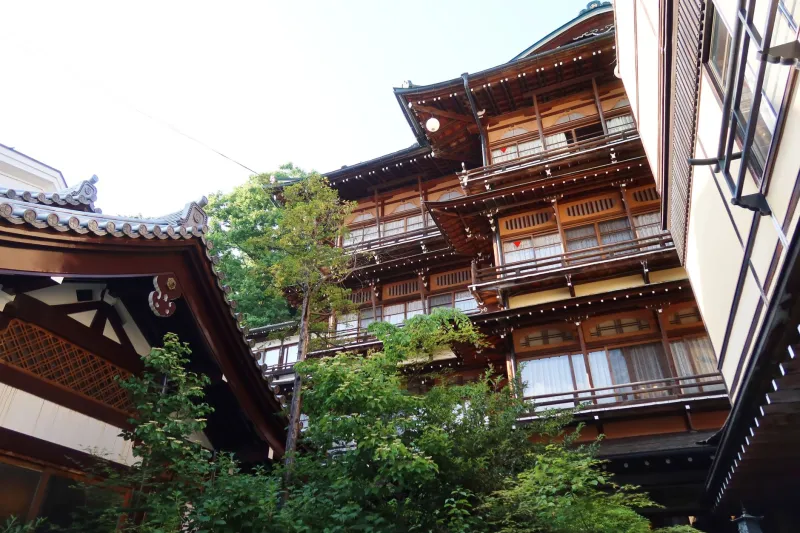
Hoshi Onsen is technically a single inn — Chojukan — but it deserves its own entry because the bathing experience here is unlike anything else in Japan. The inn was built in 1875, and the main bathhouse, a towering wooden structure with cathedral-like ceilings, has natural spring water that rises directly through the wooden floor of the bath itself. You can watch it bubble up beneath your feet.
The inn is mixed-gender during certain hours (with bathing attire permitted during those times), which is a rare and increasingly uncommon tradition in Japan. The surrounding forest is old-growth, the roads in are narrow, and the whole property feels like it exists slightly outside of normal time.
Why it works for longer stays: Hoshi Onsen is remote enough that leaving requires actual effort, which means guests tend to stay. The inn's meals — elaborate multi-course kaiseki dinners served in your room — become a genuine event each evening. By day two, you'll find yourself looking forward to dinner the way you look forward to a really good concert.
Eat like a local: Gunma is Japan's number one producer of konnyaku (a firm, gelatinous food made from konjac root), and it shows up in multiple forms at the inn's table. It sounds less exciting than it tastes — particularly when it's simmered in a rich dashi broth.
Community ritual to join: The inn sits near the start of several forest walking trails that locals use year-round. Ask the front desk for the easiest route and take a morning walk before breakfast. The forest in Gunma's mountains in autumn is the kind of thing that makes you understand why Japanese culture developed an entire aesthetic philosophy — mono no aware, the bittersweet beauty of transient things — around the changing of leaves.
The common thread running through all five of these places is time. None of them reveal themselves on a one-night stay. They're built for lingering — for the kind of slow, repetitive, deeply restful travel that most of us are desperately hungry for but rarely give ourselves permission to do.
Book a week. Leave the itinerary loose. Let the onsen set the rhythm.