Hot Water, Soft Hearts: What Soaking Together Does to a Relationship (And Why the Science Is Kind of Stunning)
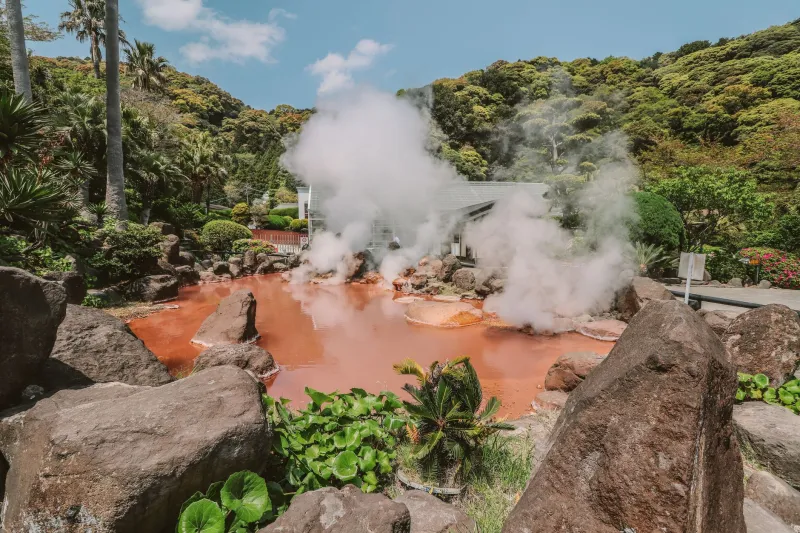
Let's be honest. Most American couples don't book a trip to Japan thinking, this is going to fix how we argue about dishes. They book it because the photos are beautiful, the food is legendary, and someone in their friend group won't stop talking about the ryokan they stayed at three years ago.
But then something happens in the water.
Not dramatically. Not in a way you could point to and timestamp. It's more like the ambient temperature of your relationship changes — slowly, and then all at once. Arguments that would've escalated back home somehow don't find the same traction. Silences that used to feel loaded start feeling, instead, like rest.
So what's actually going on? And is there a reason this seems to happen specifically in an onsen, rather than, say, a nice hotel bathtub or a spa afternoon in Scottsdale?
The answer, it turns out, involves some genuinely fascinating biology.
What Happens to Your Body When You Soak
Start with the basics. Hot water immersion — particularly in the mineral-rich thermal waters that define Japan's onsen culture — triggers a cascade of physiological responses that most of us never experience in our normal routines.
Cortisol, the stress hormone that keeps your nervous system in low-grade fight-or-flight mode, drops measurably within about twenty minutes of soaking. Your blood vessels dilate. Your heart rate steadies. Your muscles release tension that you probably didn't even know was there.
But here's where it gets interesting for couples: as cortisol falls, oxytocin tends to rise. Oxytocin — sometimes called the "bonding hormone" or the "love hormone," though researchers are careful about oversimplifying it — is associated with feelings of trust, safety, and connection. It's released during physical touch, during eye contact, during moments of shared vulnerability.
An onsen, it turns out, hits nearly every one of those triggers simultaneously.
You're physically close. You're warm. You're stripped of your usual armor — literally and figuratively. And you're in a setting that Japanese culture has spent over a thousand years designing specifically for stillness and presence.
"The combination of thermal stress relief and social closeness creates a neurochemical environment that's genuinely conducive to bonding," says one wellness researcher familiar with the intersection of hydrotherapy and relationship psychology. "You're not just relaxing your body. You're relaxing the threat-detection systems that tend to make social interactions more guarded."
In other words: you're less defended. And when two people are less defended at the same time, in the same water, something tends to open up.
The Vulnerability Factor (And Why It's the Whole Point)
Ask any American who's visited an onsen what made them most nervous beforehand, and the answer is almost always the same: the nakedness.
We are not, as a culture, particularly comfortable being unclothed in front of strangers — or even, sometimes, in front of our partners. We bring a lot of history to our bodies. Insecurities. Old criticisms. The accumulated weight of every magazine cover we've ever seen.
Jennifer and Marcus, a couple from Portland who visited Hirayu Onsen last autumn, described their first mixed-gender private bath — a kashikiri reserved just for the two of them — as unexpectedly emotional.
"I kept waiting to feel self-conscious," Jennifer said. "And then I just... didn't. The water was up to my shoulders, the light was soft, and Marcus wasn't looking at me the way I expected him to. He was just there. Quiet. And I realized I hadn't felt that seen in a really long time."
Marcus laughed when he heard her describe it that way. "I was nervous too. But once we were in, it was like all the usual noise between us just went away. We talked for two hours. Not about logistics, not about the kids, not about anything we needed to solve. We just talked."
This is, in fact, one of the more underappreciated gifts of the onsen experience for couples: it removes the agenda. There's nothing to do. Nowhere to be. No phone to glance at. No dinner reservation to rush toward. Just two people, hot water, and time.
For couples whose daily lives are structured almost entirely around tasks and obligations, this kind of unstructured presence can feel almost startlingly intimate.
Why This Doesn't Happen in a Spa Back Home
It's a fair question. American day spas offer hot tubs. Some hotels have thermal pools. Why does the onsen experience seem to produce something qualitatively different?
Part of it is cultural architecture. In Japan, bathing is not a luxury add-on to regular life. It's woven into the rhythm of the day — an evening ritual, a moment of transition, a practice that carries centuries of meaning. When you step into an onsen, you're stepping into a framework that takes stillness seriously. The design of the space, the etiquette, the quiet — all of it is structured to protect the experience from the noise of ordinary life.
American wellness spaces, by contrast, often exist in tension with the culture around them. You soak for an hour and then walk back into a parking garage and check your notifications.
The onsen, particularly when experienced as part of a multi-day stay at a traditional ryokan, creates a sustained container for a different way of being. And sustained containers, it turns out, are what actually shift relationship patterns — not one-off moments of relaxation.
Practical Advice for Couples Planning Their First Onsen Together
If you're considering an onsen trip with your partner, here's what experienced travelers consistently recommend:
Book a private bath for your first soak. Many ryokans offer kashikiri — private outdoor baths that can be reserved by the hour. This removes the social pressure of a shared public bath and lets you find your footing — emotionally and literally — before venturing into communal spaces.
Leave your phones in the room. This sounds obvious. Do it anyway. The temptation to document the experience is real, and it will cost you the experience itself.
Don't try to have a meaningful conversation. Paradoxically, the couples who report the deepest connection in the onsen are usually the ones who weren't trying to achieve anything. Let the silence do some of the work. Talk when it arises naturally.
Give yourselves time after soaking. The post-onsen glow — that soft, unhurried feeling — is worth protecting. Don't book dinner immediately afterward. Lie down. Let the shift settle.
Go more than once. The first soak is often about getting comfortable. The second and third are where the real opening tends to happen.
The Conversation That Changes Things
Sarah and David, a couple from Chicago who've now visited Japanese onsen three times, describe the experience as having fundamentally reoriented how they think about quality time together.
"We used to think quality time meant doing something together," Sarah said. "An activity, a trip, an experience. But what we kept finding in the onsen was that doing nothing together was actually more connecting than anything we'd ever planned."
David nodded. "There's this moment, usually about thirty minutes in, where you both just stop performing. Stop being on. And you're just two people who love each other, sitting in hot water, watching the steam rise. That's it. And somehow that's everything."
The science would agree. The stillness isn't incidental. It's the point.
Soak deep. Travel slow. And maybe — if you're lucky and the water is warm enough — fall a little bit back in love.