Bringing the Bath Home: What Onsen Culture Actually Teaches Us About the Way Americans Live
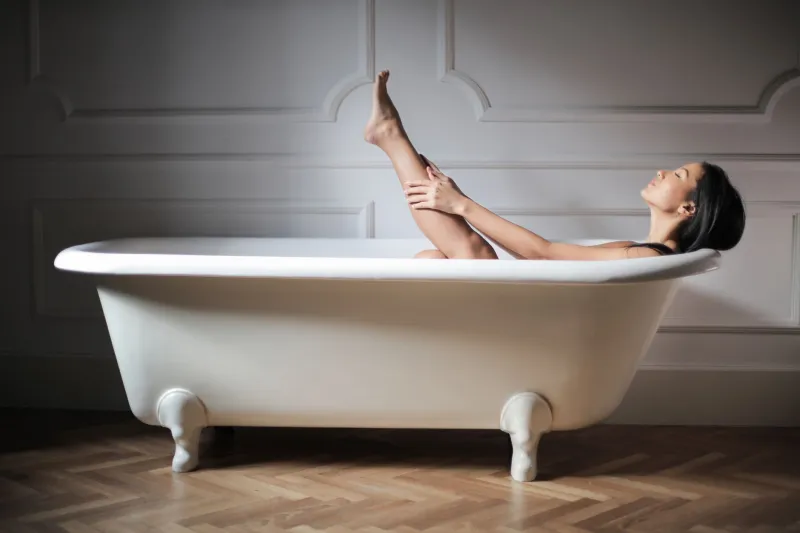
The flight home from Japan has a particular emotional texture for a lot of first-time onsen visitors. You're somewhere over the Pacific, a little jet-lagged, replaying the memory of that outdoor bath with the cedar smell and the mountain air, and you're already thinking about your bathroom at home. The one with the plastic shower curtain and the shelf of half-used products. The one you've never once spent more than ten minutes in.
You think: I want that feeling back.
It's a completely understandable impulse. And it's one that architects, interior designers, and wellness-focused builders across the US are fielding more and more often from clients who've returned from Japan with a very specific vision and a lot of Pinterest screenshots.
The results, when done well, are genuinely beautiful. When done without understanding the philosophy underneath, they're expensive rooms that still don't feel like anything.
What Onsen Culture Is Actually About
Before we get into materials and fixtures, it helps to understand what makes an onsen feel the way it does — because it's not primarily the design.
Japanese bathing culture is built around a concept of the bath as a separate world. When you enter an onsen, you leave your phone, your clothes, your social roles, and most of your self-consciousness at the door. The water is the point. The silence is the point. The unhurried time with your own body — not performing, not optimizing, just existing — is the point.
The architecture and design of traditional onsen facilities support that philosophy. They don't create it. Low lighting, natural materials, the sound of water, the absence of mirrors in the soaking area, the deliberate removal of visual clutter — all of these choices are in service of a mental state, not an aesthetic.
"Most of my clients come to me with images of beautiful Japanese baths and say they want that," says San Francisco-based architect and wellness space designer Claire Nakamura, who studied traditional Japanese architecture in Kyoto and now consults on residential projects across the Bay Area. "The first thing I ask them is: do you want the look, or do you want the experience? Because those are different projects."
What Actually Translates
The good news is that several core elements of onsen design philosophy translate remarkably well into American residential spaces — if you approach them with intention.
Natural materials over synthetic ones. Hinoki cypress wood, the signature material of many Japanese bathing spaces, brings a distinctive warmth, a subtle fragrance, and a sensory quality that no tile can replicate. In the US, hinoki is available through specialty importers and some high-end lumber suppliers, though it comes at a price. Domestic alternatives like teak, cedar, or sustainably sourced white oak can capture a similar spirit of natural warmth without the import cost.
Separation of washing and soaking. This is one of the most functionally significant differences between American and Japanese bathing design, and it's one of the easiest to implement. In Japanese bathing culture, you wash your entire body — seated, at a low faucet — before you enter the soaking tub. The tub stays clean. The water stays peaceful. Designing a bathroom with a dedicated wash area (a simple low bench, a handheld showerhead, a drain in the floor) separate from the soaking tub changes how the entire space feels and functions.
Soaking depth. American bathtubs are designed for lying down in shallow water. Japanese soaking tubs (ofuro) are designed for sitting upright in deep, hot water — typically neck-deep. This posture is more meditative, more physically effective for circulation and muscle relaxation, and takes up far less floor space. Several US manufacturers now produce deep soaking tubs in acrylic and stone resin at accessible price points.
Minimal visual noise. Onsen environments are deliberately stripped of distraction. No magazines, no TVs, no product displays. In a home bathroom, this means ruthless editing — recessed storage, simple surfaces, and an honest look at what actually needs to be in the room versus what's just accumulated there.
What Loses Its Magic
Here's where the conversation gets more honest. There are elements of the onsen experience that are genuinely, structurally untransferable to a private American home, and understanding that saves a lot of money and disappointment.
Mineral water. The therapeutic quality of onsen water comes from geothermal mineral content — sulfur, sodium bicarbonate, iron, silica — that varies by location and cannot be replicated in a residential tap. Mineral bath salts and additives can approximate some benefits, but they're not the same thing. Don't let anyone sell you otherwise.
The social dimension. Part of what makes onsen so psychologically restorative is that it happens in community — a shared space where everyone is equally vulnerable, equally quiet, equally present. A private home bathroom is, by definition, solitary. That's not a failure; it's just a different experience.
The departure from ordinary life. Onsen works in part because it's elsewhere. The physical act of traveling to a different place, changing your routine, stepping into a space that exists outside your daily context — that psychological distance is part of the medicine. A beautiful bathroom at home is still at home.
"I always tell clients that what they're really trying to recreate is a mental state, not a room," says Portland-based interior designer Tom Igarashi, who specializes in Japanese-influenced residential spaces. "The room can support that state. But you also have to actually stop, put the phone down, and give yourself permission to be in it. The design can't do that work for you."
The Backyard Rotenburo
For homeowners with outdoor space, the rotenburo — the open-air onsen bath — offers perhaps the most authentic translation of the onsen spirit. A quality cedar or hinoki soaking tub, properly sealed and heated, set in a private outdoor space with considered landscaping, can genuinely approximate the experience of soaking under open sky.
Costs range widely, from a few thousand dollars for a basic Japanese-style wooden soaking tub to $20,000 or more for a custom stone installation with privacy screening and integrated heating systems. The investment, for those who commit to actually using the space regularly, tends to pay psychological dividends that are hard to quantify.
The Lesson Underneath the Design
Ultimately, what onsen culture is trying to teach Americans isn't about bathroom fixtures or tile selections. It's about the radical act of treating restoration as a daily practice rather than an occasional reward.
The Japanese don't soak once a month as a treat. They soak every day, as a matter of course, because they've built a culture that understands the body needs warm water and stillness the way it needs sleep and food.
You can build a beautiful Japanese-inspired bathroom. You can order the hinoki bench and the deep soaking tub and the pebbled floor drain. But the most important design decision is the one you make every evening when you choose, or don't choose, to actually get in.
The water is ready. The rest is up to you.