What's Actually in the Water: A Traveler's Guide to Japanese Onsen Minerals and What They Do to Your Skin
Not All Hot Springs Are Created Equal
If you've ever stood in two different onsen on the same Japan trip and noticed that one left your skin silky for days while the other did basically nothing, you weren't imagining it. Japanese hot springs are geologically and chemically distinct from one another in ways that matter — not just as interesting trivia, but as practical guidance for choosing where to go based on what you actually want out of the experience.
Japan's Ministry of the Environment officially classifies onsen water into ten distinct types based on mineral content. Each type has a different effect on the body, different visual and sensory characteristics, and a different regional distribution across the country. Most international visitors have no idea this classification system exists. Once you do, the way you plan a Japan trip changes.
Let's break it down honestly — including where the science is solid and where it shades into marketing.
The Ten Types (And the Ones Worth Knowing First)
Japan's official onsen designations cover simple thermal water, carbon dioxide springs, hydrogen sulfide springs, sulfur springs, acidic springs, iron-containing springs, sodium bicarbonate springs, sodium chloride springs, calcium sulfate springs, and radioactive springs (radon). In practice, most onsen fall into a handful of types you'll actually encounter as a traveler.
Sulfur Springs (Ryuuousen)
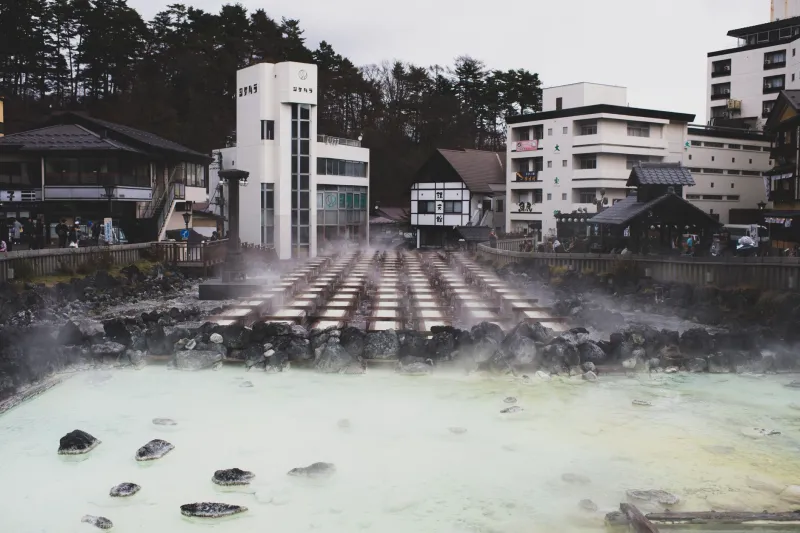
These are the ones that smell like eggs — dramatically so, in some cases. The sulfurous odor comes from hydrogen sulfide gas, and it's not subtle. Kusatsu Onsen in Gunma Prefecture is Japan's most famous example and draws visitors specifically for this water.
What sulfur water actually does: sulfur compounds have documented antimicrobial and keratolytic properties, meaning they help break down the outer layer of dead skin cells. For people dealing with certain dermatological conditions — psoriasis, eczema, chronic acne — sulfur baths have been used therapeutically in European and Japanese spa medicine for over a century. The research base here is more substantial than for most onsen types. That said, sulfur springs are also highly acidic and can be irritating for sensitive skin. If you burn easily or have reactive skin, start with short sessions.
Sodium Chloride Springs (Enmizensen)
Essentially a salt bath, but at concentrations and temperatures far beyond anything you'd achieve at home. Sodium chloride springs are among the most common in Japan and among the most broadly accessible for people with no specific skin concerns.
The mechanism is straightforward: the salt creates a thin mineral film on your skin after you exit the bath, which slows moisture evaporation. In practical terms, your skin feels soft and hydrated for an unusually long time after soaking. These springs also warm you deeply and efficiently — bathers often stay warm for hours after exiting, even in cold weather. Hirayu Onsen's waters have sodium chloride properties that contribute to this signature warming effect, which is part of why the region is particularly beloved in winter.
Sodium Bicarbonate Springs (Juusosen)
Known colloquially in Japan as "beauty springs" (bijin no yu), sodium bicarbonate waters have a slightly alkaline pH that gently emulsifies skin oils and removes dead skin cells without stripping the skin barrier. The water often feels almost slippery — noticeably different from regular water — and many bathers describe their skin as unusually smooth within a single session.
The "beauty spring" label is aggressively marketed by Japanese tourism, and the reality is more modest than the branding suggests. You're not going to reverse sun damage in one soak. But the mild exfoliating effect is real and measurable, and for travelers with dry or dull skin, these springs consistently deliver a noticeable result. Tsuru no Yu in Akita Prefecture is one of the most celebrated examples.
Iron Springs (Gantetsusen)
These are visually unmistakable: the water ranges from orange to deep rust-brown, and it stains everything it touches, including swimsuits, towels, and occasionally grout. Arima Onsen in Hyogo Prefecture has two distinct water sources, and the iron-rich "gold spring" is one of the most famous examples in Japan.
Iron springs are often promoted for circulation and fatigue recovery, and there's some physiological basis for this — iron is absorbed transdermally to a limited degree, and the warming effect of these springs is pronounced. The honest caveat: transdermal iron absorption is a relatively minor pathway compared to dietary intake, so treating an iron deficiency by soaking in Arima is not a medically sound strategy. As a wellness experience with circulation-boosting warmth and a genuinely dramatic sensory quality, though, iron springs are hard to beat.
Acidic Springs (Sanseisen)
These are the most aggressive waters in Japan's onsen inventory. Highly acidic springs — pH values sometimes below 2, comparable to vinegar — have strong antimicrobial properties and are used in traditional Japanese practice for skin conditions and chronic infections. Tamagawa Onsen in Akita is one of the most extreme examples, with pH levels that require limited soak times and are genuinely contraindicated for people with open wounds or very sensitive skin.
For healthy skin, brief exposure to mildly acidic springs can produce a tightening, clarifying effect. Extended or unsupervised soaking in highly acidic water is not advisable without guidance from onsen staff.
Reading the Signs: What Japanese Labels Are Telling You
Most Japanese onsen facilities post the water analysis (suishitsu bunseki) on a board near the bath entrance or in the changing room. Even without reading Japanese fluently, a few key terms are worth recognizing:
- 泉質 (Senshi) — Spring type/classification
- pH値 (pH chi) — pH value (lower = more acidic, higher = more alkaline)
- メタケイ酸 (Meta keisan) — Metasilicic acid, associated with skin softening
- 硫黄 (Iou) — Sulfur
- 鉄 (Tetsu) — Iron
- ナトリウム (Natoriumu) — Sodium
- 源泉かけ流し (Gensen kake nagashi) — Indicates the water flows directly from the source without dilution or recirculation — generally considered the highest quality designation
That last one matters more than most travelers realize. Many urban or resort onsen facilities dilute their water, add city water, or recirculate and reheat the same water. Gensen kake nagashi springs use fresh spring water continuously flowing through the bath. The mineral experience is meaningfully different.
Regional Breakdown at a Glance
Gunma Prefecture (Kusatsu, Shima): Sulfur-dominant, highly acidic, excellent for skin conditions, strong odor, not for sensitive skin.
Hyogo Prefecture (Arima): Iron-rich gold springs plus sodium chloride silver springs — two distinct water types in one town, both exceptional.
Akita Prefecture (Nyuto Onsenkyo, Tamagawa): Sodium bicarbonate beauty springs at Tsuru no Yu; highly acidic therapeutic springs at Tamagawa.
Gifu Prefecture (Hirayu, Okuhida area): Sodium chloride springs with notable warming properties; excellent for general wellness, circulation, and cold-weather soaking. Multiple gensen kake nagashi facilities.
Nagano Prefecture (Shirahone, Nozawa): Calcium carbonate springs at Shirahone produce milky white water with skin-smoothing effects; Nozawa offers sodium chloride springs in a beautifully preserved village setting.
The Honest Expectation Check
Japanese onsen water is genuinely interesting from a mineral chemistry standpoint, and certain types have real, documented effects on skin and circulation. But the wellness tourism industry — in Japan as much as anywhere — has a tendency to overstate what a soak will do.
You are not going to cure arthritis in Kusatsu, though the warmth and sulfur may reduce inflammation temporarily. You are not going to achieve permanent skin transformation from a single visit, though sodium bicarbonate springs will make your skin feel noticeably different for a day or two. Onsen bathing is a wellness practice, not a medical treatment — and it works best when approached as a consistent ritual rather than a one-time fix.
What you will reliably get: deep relaxation, genuine skin effects that vary meaningfully by water type, and a sensory experience of Japanese bathing culture that no spa in the United States can replicate.
That's enough. That's actually quite a lot.