Hot Water, Clear Head: How Soaking in a Japanese Onsen Became the Decision-Making Tool Americans Didn't Know They Needed
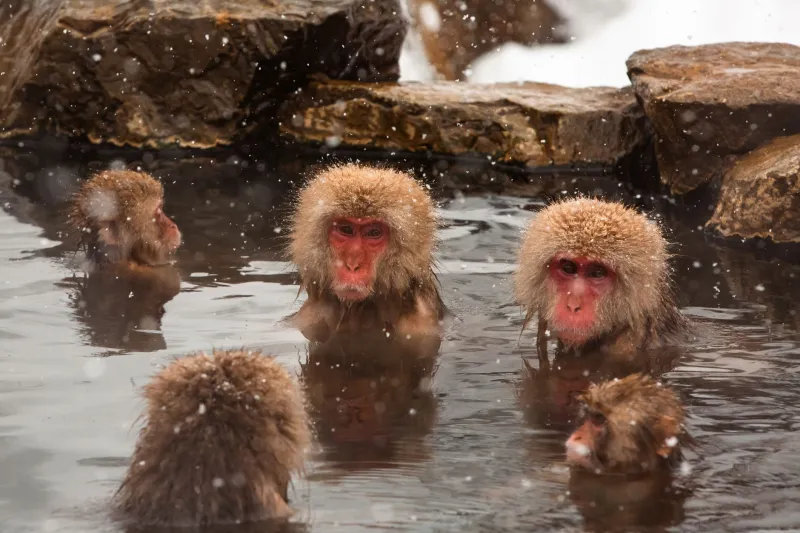
Marcus Webb had been sitting on a job offer for three weeks. Senior director role, significant pay bump, relocation from Portland to New York. His spreadsheet had seventeen rows. He'd talked it through with his wife, his therapist, his college roommate, and at least two strangers at a bar. He still had no idea what to do.
Then he went to Japan.
"I wasn't even thinking about the job when it happened," he says. "I was just sitting there in this outdoor bath in Hirayu, watching snow fall into the steam, and suddenly I just... knew. Like the decision had been made for me while I wasn't looking."
He turned the offer down. Moved to the coast of Oregon instead. Hasn't second-guessed it once.
Stories like Marcus's are more common than you'd expect. Spend any time in Japan's onsen towns — particularly the quieter, slower ones tucked into mountain valleys — and you start to hear a pattern. Americans who came for a vacation and left with a completely different life plan. Not because anything dramatic happened. Because nothing happened. And that, it turns out, is exactly the point.
Your Brain Is Doing Something in There
Let's get into the science for a second, because this isn't just vibes.
When you lower your body into hot mineral water, a cascade of physiological changes kicks off almost immediately. Core temperature rises. Blood vessels dilate. Your parasympathetic nervous system — the one responsible for rest and digestion, as opposed to the fight-or-flight response — takes the wheel. Cortisol levels drop. Heart rate steadies.
This is the state neuroscientists sometimes call "diffuse mode" thinking. Your prefrontal cortex, the part of the brain that handles focused analytical tasks, loosens its grip. And when that happens, the brain's default mode network activates — the same network associated with daydreaming, self-reflection, and what researchers call "insight thinking."
In plain English: when you stop trying to solve the problem, your brain actually starts solving it.
"We tend to think of decision-making as a conscious, rational process," says Dr. Leanne Cho, a behavioral psychologist based in San Francisco who has studied the relationship between relaxation states and cognitive clarity. "But a huge amount of the processing that leads to genuine insight happens below the surface. The challenge is that most of us never give our brains the conditions to get there. We're always in focused mode — scrolling, planning, analyzing. We're never truly off."
Onsen, she argues, is one of the few environments that forces genuine cognitive downtime. No phone (most bathhouses discourage them, and many ban them outright). No conversation. No agenda. Just heat, water, and time.
What Makes Onsen Different From Just Taking a Hot Bath
Fair question. You have a bathtub at home. Why fly to Japan?
The honest answer is: because context matters enormously. Your bathtub is surrounded by your to-do list, your bathroom renovation you've been putting off, and the sound of your neighbor's TV. An onsen in a mountain village is surrounded by cedar forests, river sounds, and a cultural expectation of silence that's been baked in for centuries.
Japanese onsen culture operates on a kind of unspoken agreement. You don't bring your noise in here. You don't bring your rush. The bathhouse is a liminal space — between the outside world and something quieter — and that liminality is baked into the architecture, the ritual, the temperature of the air. Even the act of undressing, of leaving your clothes and your wallet and your phone in a wooden locker, functions as a kind of psychological permission slip. You are not that person right now. You're just a person in water.
There's also the mineral content to consider. The waters in Hirayu, for instance, are rich in calcium, magnesium, and sodium bicarbonate. These aren't just good for your skin. Transdermal absorption of magnesium — absorbed through the skin during a soak — has been linked in some studies to reduced anxiety and improved mood regulation. You are, quite literally, bathing in calm.
The Decisions People Make in the Water
Jamie Okafor, a graphic designer from Austin, had been putting off ending a five-year relationship. She knew, somewhere deep down, that it wasn't working. But knowing and acting are different things, and the gap between them had stretched into years.
"I went to Japan solo, which was already a big deal for me," she says. "And I started going to the onsen every morning, just as a routine. By the fourth or fifth morning, I wasn't even thinking about him. I was thinking about what I wanted my life to look like. And then I realized those two things were incompatible."
She came home, had the conversation, and moved into her own apartment within the month. "I don't think the onsen made the decision. I think it just got out of the way so I could hear what I already knew."
That framing — getting out of the way — comes up again and again. The onsen doesn't tell you what to do. It just quiets the noise long enough for your own signal to come through.
For Daniel Reyes, a former corporate attorney from Chicago, the clarity came about the career he'd been building for fifteen years. "I'd been telling myself I just needed a vacation. But sitting in that bath, watching the mountains, I realized I hadn't been on vacation — I'd been hiding. And the thing I was hiding from was the fact that I genuinely hated my life."
He's now running a small pottery studio in Vermont. He laughs when he tells the story, partly because it sounds insane to him too.
How to Create the Conditions for Your Own Clarity
If you're sitting with a big decision — a career move, a relationship crossroads, a geographic leap of faith — here's what the onsen experience actually teaches you about creating the right mental environment.
Go in without an agenda. Don't go to the bath to figure things out. Go to be warm. The insight will arrive when you stop hunting for it.
Stay longer than feels comfortable. Americans tend to treat the onsen like a shower — get in, get clean, get out. But the real shift happens around the twenty- or thirty-minute mark, when your nervous system has fully surrendered. Stay.
Leave your phone in the locker. Not on silent. In the locker. The difference is psychological, not just practical.
Come back the next morning. And the one after that. Single sessions are nice. A week of daily soaking is transformative. The accumulation matters.
Trust the quiet. This is the hardest one for most Americans. We're trained to fill silence. In the onsen, silence is the whole point. Let it do its work.
The Slow Answer
There's a phrase in Japanese — yukkuri — that roughly translates to "slowly" or "take your time." It's something you hear a lot in onsen towns. At check-in, after a meal, when you're heading to the bath. Yukkuri shite kudasai. Please take your time.
It's such a small thing. But when you've spent years in a culture that treats urgency as a virtue, being given explicit permission to slow down does something to you.
The onsen, at its core, is a practice in trusting slowness. And as it turns out, your best thinking — your most honest self-assessment, your clearest sense of what you actually want — lives in the slow lane.
You just have to get in the water long enough to find it.