Hot Water and Heavy Hearts: How Onsen Became an Unlikely Sanctuary for Americans Carrying Grief
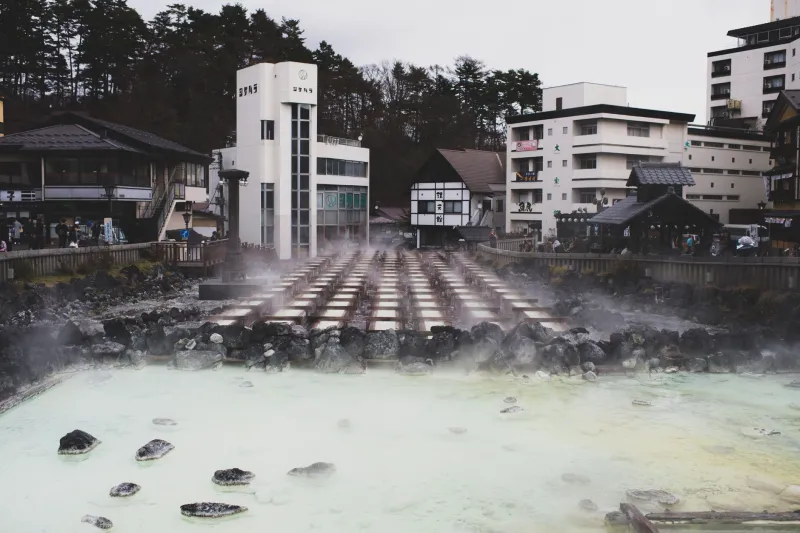
Laura hadn't cried in six months. Not at the funeral. Not during the long drive back from her mother's house in Ohio with a car full of boxes. Not through any of the three therapy sessions she'd dutifully attended before quietly letting them lapse. She'd kept moving, the way Americans tend to do, because stopping felt dangerous.
She booked the trip to Japan on a Wednesday night, half-asleep, mostly on instinct. She didn't research onsen culture. She didn't read about mineral content or bathing rituals. She just knew she needed to go somewhere that didn't know her name.
She cried in the bath on her second evening in Hirayu. Quietly, in the steam, alone in the water. Nobody noticed. Nobody needed to.
"It wasn't dramatic," she told us over email, months later. "It was just... finally."
What Western Wellness Gets Wrong About Grief
American wellness culture is remarkably good at offering things to do with pain. Journaling prompts. Breathwork sequences. Grief support groups with folding chairs and bad coffee. There's a productivity baked into how we approach emotional processing — a sense that if you just apply the right technique with enough consistency, you'll come out the other side on schedule.
But grief doesn't work on a schedule. And many of the Americans who've found their way to Japanese onsen towns during periods of profound loss describe something that Western modalities often struggle to provide: a container that doesn't ask anything of you.
Dr. Keiko Tanaka, a cultural anthropologist based in Kyoto who has spent years studying the social function of communal bathing in Japan, puts it this way: "The bath in Japanese culture has never been purely about hygiene or even relaxation. It is a liminal space. You enter it as one version of yourself and you leave as something slightly different. This has been understood intuitively for centuries."
Liminal. The word keeps coming up in conversations about onsen and grief. That threshold state — neither here nor there, neither who you were nor who you're becoming — is exactly where loss lives. And hot springs, it turns out, are remarkably good at holding that space.
The Body Knows Before the Mind Does
There's real physiology at work here, not just metaphor. Immersion in hot mineral water triggers a measurable drop in cortisol, the stress hormone that keeps the nervous system locked in protective mode. It activates the parasympathetic nervous system — the biological state associated with rest, digestion, and, crucially, emotional processing.
In plain terms: the bath tells your body it's safe. And when the body finally believes it's safe, things that have been held at bay tend to surface.
Marcos, a graphic designer from Austin, lost his father and his long-term relationship within the same four-month stretch. He describes his first solo onsen experience in terms that sound almost neurological: "My shoulders dropped about three inches. I didn't even realize I'd been holding them up. And then it was like everything I hadn't let myself feel just... came up through the water."
He sat in the outdoor rotenburo for almost an hour, watching steam rise into the dark cedar trees, letting his mind go wherever it needed to go. No phone. No music. No one to perform okayness for.
"It was the first time since everything happened that I wasn't trying to be fine," he said.
Silence as a Healing Technology
Onsen etiquette requires quiet. Not the performative quiet of a yoga class where someone's still going to whisper to their neighbor — genuine, sustained, expected silence. Conversation in the bath is discouraged. Phones are prohibited. The only sounds are water, breath, and the occasional distant bird.
For Americans accustomed to filling every silence with noise, this can feel uncomfortable at first. And then, for many, it feels like relief.
There's a concept in Japanese culture called ma — the productive pause, the meaningful empty space. It shows up in architecture, in music, in conversation. The onsen embodies ma in physical form. You are given nothing to do and nowhere to be, and in that emptiness, something moves.
Grief counselors in the US have long known that the most powerful moments in the therapeutic process often aren't the moments of articulation but the moments of stillness that precede them. The onsen, almost accidentally, creates those conditions at scale — for hours at a time, across multiple days, in a setting stripped of every familiar distraction.
The Ritual Matters As Much As the Water
It's not just the soaking. The ritual structure of onsen bathing — the careful washing before you enter, the deliberate transition from the changing room to the bath, the unhurried movement between indoor and outdoor pools — creates a kind of ceremony around the experience that Western wellness rarely offers outside of explicitly spiritual contexts.
Ritual, psychologists tell us, is one of the most effective tools humans have for marking transitions. It signals to the brain that something significant is happening, that one chapter is ending and another beginning. Memorial services exist for this reason. So do weddings and graduations.
But what do we have for the smaller, harder transitions? The end of a marriage. The loss of a career identity. The slow grief of a friendship that simply faded. American culture doesn't offer much ceremony for those.
The onsen does. Every time you lower yourself into the water, you are, in some small way, performing a transition ritual. And when you do it repeatedly, across days, in a place that carries centuries of meaning, it starts to accumulate into something that feels almost sacramental.
You Don't Have to Call It Healing
Not everyone who comes to the onsen in a tender emotional state frames their experience in therapeutic terms. Some people just call it a good trip. Some call it the thing that finally let them breathe. Some, like Laura from Ohio, just call it "finally."
And that might be the point. The onsen doesn't ask you to name what you're carrying or explain where it came from. It doesn't have a curriculum or a framework. It just offers hot water, silence, and time — three things that grief has always needed and modern life rarely provides.
If you're navigating a hard season and you're wondering whether a week in a Japanese hot spring town could actually do anything for you, the honest answer is: we don't know. Grief is specific and strange and nobody else's experience is yours.
But we do know that the water is old, and the silence is real, and for a lot of people who arrived carrying something heavy, the bath gave them a place to finally set it down.
Sometimes that's enough to start.