Paper Maps, Old Guidebooks, and No Signal: How Americans Are Rediscovering the Art of Getting Intentionally Lost on the Way to the Bath
Somewhere between the third wrong turn and the moment a retired farmer wordlessly pointed toward a cedar-scented valley, Sarah Chen realized something had shifted. She wasn't frustrated. She was present.
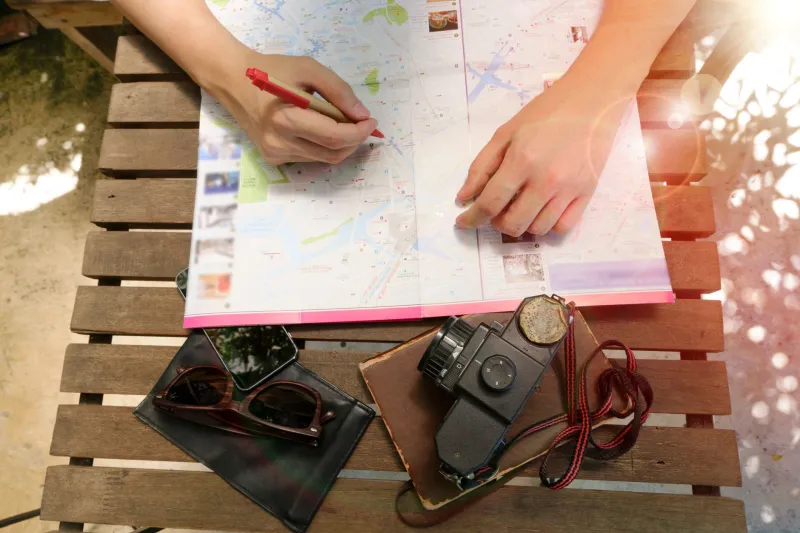
Sarah, a project manager from Portland, Oregon, had spent weeks before her trip to Japan's Gifu Prefecture doing something her coworkers found baffling: she'd ordered a 2009 Japanese onsen guidebook from a used bookstore in Seattle, printed regional train maps from a tourism bureau PDF, and made a handwritten list of bath towns recommended by a Japanese-American neighbor who'd grown up in Takayama. She left her phone in airplane mode for the entire first week.
"I realized I'd never actually planned a trip before," she said. "I'd just followed arrows."
Sarah isn't alone. Among a small but growing segment of American wellness travelers, analog onsen planning has quietly become its own ritual — one that begins long before anyone steps into steaming water.
The App Is the Problem
It sounds counterintuitive, right? Navigation apps exist to make travel easier. But ease and depth are not the same thing. When every step of a journey is optimized, the journey itself disappears. You arrive at coordinates. You leave coordinates. The space between — the wrong alley, the unexpected shrine, the noodle shop with no English menu that turns out to be extraordinary — gets routed around.
For many Americans, onsen travel is specifically about recovering something that's been optimized away. The whole premise of soaking in a mountain hot spring is deceleration. So there's an obvious tension in sprinting through that experience with a glowing screen in your hand.
Wellness researchers have started paying attention to this. The concept of "digital sabbaticals" — structured periods of intentional disconnection — has gained real traction in the US over the last few years. But what's interesting about the onsen pilgrimage crowd is that they're not just turning off their phones at the bathhouse door. They're building the disconnection into the journey architecture itself.
What an Old Guidebook Actually Gives You
There's something a 2009 guidebook can do that no app can replicate: it tells you what a place felt like to someone who was paying attention.
Old travel writing is full of texture. A description of Hirayu Onsen in the Northern Alps that mentions the smell of cedar smoke and the way the innkeeper's grandmother still brings towels folded in the old style — that's not a data point. That's an invitation to notice.
American travelers who've adopted this approach often describe the same experience: they read older descriptions of places, form mental images, and then show up to compare. Sometimes the place has changed. Sometimes it hasn't. Either way, they're engaging with the location rather than just consuming it.
Mark Okafor, a high school history teacher from Columbus, Ohio, spent three weeks last spring crossing between onsen towns in Nagano and Niigata with nothing but a JR rail map and a stack of index cards covered in recommendations from an online forum of Japanese onsen enthusiasts. "I missed two baths I'd planned to visit because I took the wrong train," he said. "And I ended up at this tiny konyoku — mixed bath — in a town I'd never heard of, completely by accident. It was the best thing that happened to me all year."
The Planning as Practice
Here's the idea that keeps coming up when you talk to these travelers: the planning itself is wellness work.
In American culture, planning a vacation usually means booking platforms, comparison shopping, and reading reviews until the whole thing feels like a procurement project. There's very little pleasure in it. But sitting down with a paper map and tracing a route between bath towns — deciding which mountain pass to cross, which regional train line to ride, which small inn to try based on a single handwritten note from someone who stayed there six years ago — that process is slow, tactile, and genuinely absorbing.
It requires imagination. It requires tolerance for uncertainty. Both of those are muscles that atrophy when apps do the thinking for you.
Several of the travelers we spoke with described evening sessions before their trips where they'd spread maps across kitchen tables, cross-reference notes, and mark routes in pencil. They used words like "meditative" and "calming." One woman from Austin said it reminded her of the feeling she'd had as a kid planning road trips with her dad using a AAA TripTik. "That feeling of anticipation, of a journey being something you could hold in your hands," she said. "I didn't know I missed it until I got it back."
How to Actually Do This
If you want to try analog onsen planning, a few practical notes from people who've done it:
Start with the Japan National Tourism Organization. Their printed materials are genuinely excellent and available for free. Regional tourism boards — particularly in areas like Gifu, Nagano, and Akita — often publish beautifully detailed paper maps in English.
Find a human source. This is the most underrated step. Japanese-American community centers, Japan-focused travel forums, and even local Japanese restaurants whose owners have family in onsen regions can be goldmines of specific, personal recommendations that no algorithm will surface.
Build in buffer days. Analog travel requires slack in the schedule. If you're booked solid, you can't follow the farmer's pointed finger down the cedar valley. Leave room for the accident.
Accept that you'll miss things. You will not see everything. That is the point. Depth over coverage is the entire philosophy.
Keep a journal. Not Instagram. A notebook. The act of writing down what you saw and felt — without filtering it for an audience — is its own form of the onsen experience. It's private. It's yours.
What This Says About Us
There's something worth sitting with here. The Americans drawn to this kind of travel aren't Luddites. They're people who live inside technology all day and have started to notice what it costs them. The hunger for a paper map isn't nostalgia, exactly. It's a recognition that the interface between a person and a place matters — that how you arrive somewhere shapes what you find there.
Japanese onsen culture has always understood this. The journey to the bath is part of the bath. The mountain road, the wooden bridge, the smell of sulfur drifting through cedar trees before you've even seen the water — these are not inconveniences to be navigated around. They are the experience.
Maybe that's what the paper map is really for. Not to find the place. To become the kind of person who can receive it.