The Camera Stays in the Bag: What Happens When You Stop Trying to Capture Japan and Start Letting It Capture You
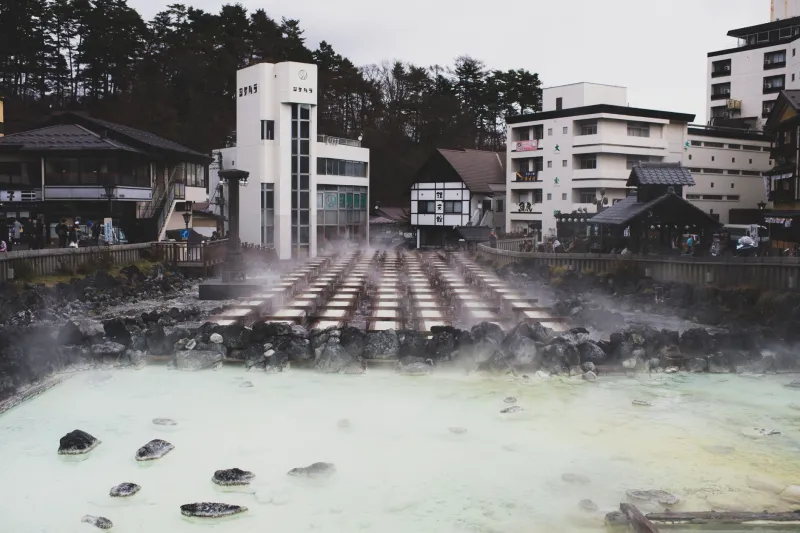
Kayla from Denver had a plan. A really good one, actually. She'd spent three weeks before her Japan trip building a content calendar, scouting photo locations on Pinterest, and bookmarking every outdoor rotenburo that had ever appeared in a travel reel. She'd packed a waterproof phone case. She had a tripod. She had presets.
She came home with 1,400 photos and a vague, nagging sense that she'd missed something.
"I kept looking at my shots thinking, this is gorgeous — why do I feel nothing?" she said. "I was there. I was standing in the water. But looking at the pictures, it's like watching someone else's vacation."
Kayla's experience isn't unusual. It might, in fact, be the defining tension of modern travel — and nowhere does it reveal itself more clearly than in a Japanese onsen.
The Most Photogenic Place You're Not Supposed to Photograph
Here's the paradox that every onsen-bound traveler eventually bumps into: the settings are extraordinary. Wooden bathhouses draped in steam. Water the color of old jade. Snow-dusted pine trees framing an open-air bath under a gray winter sky. The composition practically frames itself. Your phone hand twitches.
And then you read the signs. No cameras. No phones. Definitely no filming.
For a lot of American visitors, this lands somewhere between inconvenient and genuinely distressing. We live in a culture that has quietly redefined experience as something that only counts when it's documented. If you didn't post it, did it even happen? The onsen, blissfully indifferent to your follower count, says: yes. Obviously yes. What's wrong with you.
The no-photography rule isn't arbitrary — it exists because communal bathing is built on a foundation of trust, modesty, and mutual respect. But for visitors willing to sit with the discomfort of the undocumented moment, something unexpected tends to happen.
They actually relax.
What Your Nervous System Does When the Phone Disappears
Marcus, a marketing director from Austin, described his first onsen experience as "accidentally therapeutic." He'd been annoyed about the no-phone policy for about ten minutes. Then something shifted.
"There was literally nothing to do," he said. "No one to compare myself to. No angle to find. No caption to think of. I just... sat in the water. And at some point I realized my shoulders were down around my actual shoulder level instead of somewhere near my ears."
This isn't just poetic. There's a real neurological argument for what Marcus experienced. The act of reaching for your phone — even anticipating reaching for it — keeps your brain in a low-grade state of alertness. Notifications, metrics, the subtle social pressure of crafting a shareable moment: all of it signals to your nervous system that there's work to be done. The hot spring, enforcing its quiet rules, removes the option entirely. Your brain, eventually, gets the memo.
Japanese onsen culture has understood something about this for centuries without needing a neuroscience citation. The bath is not a backdrop. It is the thing itself.
The Content Creator's Reckoning
Not everyone comes to this realization peacefully. Jamie, a travel content creator from Portland with a mid-size following, planned an entire Japan trip around what she calls her "onsen content arc." She'd negotiated permission to photograph the exterior of a historic bathhouse in Gifu prefecture, sourced a ryokan that allowed limited photography in a private bath, and lined up a sunrise shoot at an outdoor spring.
She got her content. It performed well. And then, on the last day of her trip, she wandered into a small neighborhood sento — a public bathhouse — in a town she'd stopped in purely by accident. No camera. No plan. Just her, a wooden bucket, and a room full of older Japanese women who paid her approximately zero attention.
"I sat in that bath for two hours," she said. "Two hours. I don't sit anywhere for two hours. I cried a little, which was embarrassing, but nobody cared. I came out feeling like I'd been wrung out and refilled with something cleaner."
She posted nothing about it. It remains, she says, her clearest memory of the entire trip.
Presence as a Radical Act
There's a concept in Japanese aesthetics called ma — often translated as negative space, or the meaningful pause between things. It's the silence between notes in music, the empty room that makes the full room feel full. Onsen culture embodies ma in a physical form. The steam, the stillness, the unscheduled hour: these aren't gaps in your itinerary. They are the itinerary.
For Americans conditioned to optimize every moment, this is genuinely countercultural. We've built entire industries around the idea that idle time is wasted time. The hot spring disagrees. It asks you to do one thing — be in it — and offers nothing else in return except the slow, almost embarrassing realization that this is enough.
This is, notably, also what makes onsen experiences so difficult to market. The transformation that happens in the water is fundamentally personal and stubbornly non-transferable. You can photograph the mist. You cannot photograph the moment your jaw unclenches for the first time in six months.
So What Do You Actually Bring Home?
Kayla, the Denver traveler with the 1,400 photos, went back to Japan the following year. Different approach. She left the tripod at home. She kept her phone in her room during bath time. She took maybe 200 pictures the entire trip, most of them food.
"I remember so much more," she said. "The way the water smelled like sulfur and cedar. This older man who laughed at something I couldn't understand and I laughed too. The weight of the silence in the changing room. None of that is in any photo. All of it is in my body."
That's the onsen paradox, distilled: the less you try to hold onto the experience, the more of it stays with you. The camera optimizes for the image. The bath optimizes for you.
Put the waterproof case back in the drawer. Leave the presets for another trip. Sink into the water, look up at whatever sky is above you — gray or blue or full of snow — and let Japan do the one thing it does better than anywhere else on earth.
Let it be enough.